I recently had the privilege of traveling to Kenya as part of a FAM (Familiarization) trip with SKYIN Safari. Eight days. Five destinations. More wildlife, culture, and perspective than I can fully put into words — but I’m going to try.
FAM trips are how travel advisors experience destinations firsthand, so that when a client asks “Is it worth it?” the answer comes from someone who has actually been there. Not from a brochure. Not from a website. From someone who stood on the edge of the Great Rift Valley, shook hands with a Maasai chief, watched lions feed on the Mara, and completed the Big Five in the final ten minutes of the final game drive of the trip.
This is that story.
Day 1 — Nairobi
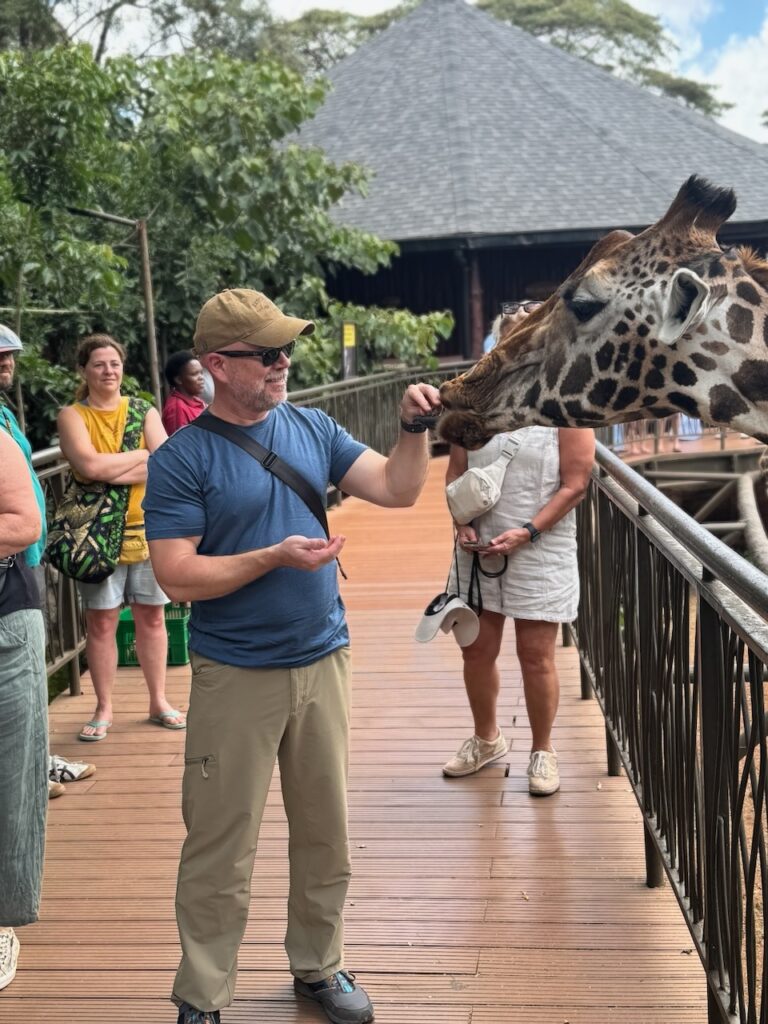 Elephant orphans, a giraffe that had opinions about my hat, and ostrich meatballs that changed my life.
After sleeping off a long overnight flight, I met up with our group for breakfast — a buffet that mixed local Kenyan flavors with just enough familiar options that I still managed to score my favorite omelette. Small wins.
We also got to meet Skyler, the owner of SKYIN Safari. Day 1 was technically supposed to be a free day, but since we were all together and raring to go, Skyler rearranged the schedule on the spot and took us out. Best decision of the trip.
David Sheldrick Wildlife Trust
First stop: the elephant orphanage at the David Sheldrick Wildlife Trust. Founded in 1977, this organization has hand-raised over 250 orphaned elephants and returned more than 200 of them to the wild — alongside orphaned rhinos and zebras. We arrived just in time for the midday mud bath, which is exactly as chaotic and joyful as it sounds. It’s genuinely hard to explain how moving it is to watch these animals get a second chance.
Nairobi Giraffe Centre
From there we headed to the Nairobi Giraffe Centre, home to the endangered Rothschild giraffe. The centre has been a critical part of growing the Rothschild population in Kenya since 1979 — and yes, you get to hand-feed them. The signs warned us to watch out for headbutts. One of them went straight for my ball cap. I think she had strong opinions about it. Still a 10/10 experience.
Dinner at The Carnivore
The evening ended at The Carnivore, a Nairobi institution since 1980 — a Brazilian-style steakhouse where meats come around on skewers and you say yes or no to things you might not recognize. Mountain oysters from an ox came around. That was a hard no. The ostrich meatballs, however, were probably the best thing I’ve eaten in years. Order them.
Day 2 — Amboseli National Park
A freight truck off a bridge, Kilimanjaro appearing through the clouds, and elephants everywhere.
We rolled out of Nairobi around 8am for the four-hour drive to Amboseli. About an hour in, a freight truck had gone off a bridge and gridlocked traffic for miles in every direction. Our safari vehicles, built for off-road, simply went around it through the bush. If you tried that on the interstate back home, you’d have a very different outcome. Out here it was just… Tuesday.
Before entering the park, we stopped for a property inspection at Tawi Lodge — an intimate, 5-star property with just 13 rooms, nearly all of them facing a private watering hole. While we were at lunch, zebras, elephants, giraffes, and baboons wandered right up to the water in front of us. No fence. No zoo. Just Africa being Africa. Tawi Lodge is exceptional, and I’ll be recommending it.
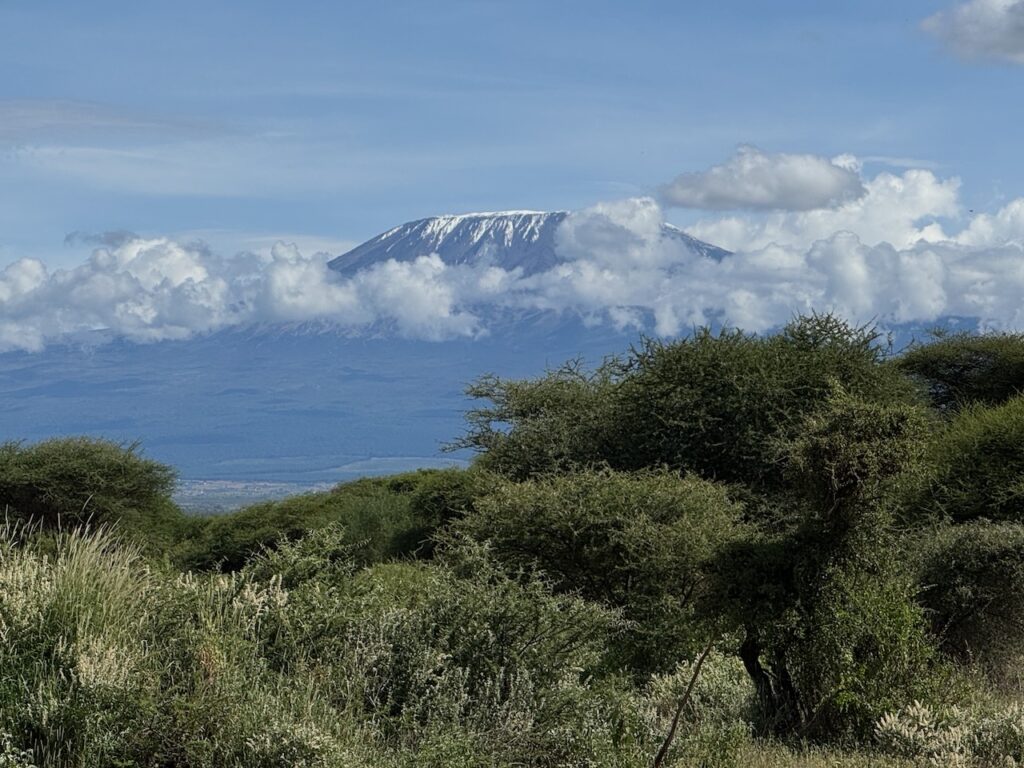 — In Person
On the drive in, the clouds parted and there it was: Mt. Kilimanjaro, 19,341 feet of it, rising out of the flat savanna about 14 miles away. The tallest free-standing mountain in the world and the highest peak in Africa — and it just appears, enormous and snow-capped, out of nowhere. Photographs do not do it justice. You kind of just stand there.
Amboseli National Park
Amboseli is called the “Courtyard of Kilimanjaro” for good reason. It’s a UNESCO Biosphere Reserve covering 392 square kilometers — modest in size but extraordinary in what it holds. Around 1,600–1,900 African savanna elephants call it home, and thanks to the Amboseli Elephant Research Project, which has been running since 1972, every single one of them is known by name and family lineage. The underground water that sustains the park’s swamps comes from snowmelt filtering down from Kilimanjaro’s slopes 50 kilometers away. That mountain is literally feeding the ecosystem from underground. Mind blown.
Our afternoon game drive delivered exactly what the park promises: elephant herds moving alongside our vehicle, giraffes, gazelles, warthogs, over 400 species of birds, and Kilimanjaro as the constant backdrop with distant rainstorms rolling across the horizon. There’s nothing else like it.
We settled in for the night at Oltukai Lodge, which sits inside the park. Our welcome committee at the gate? A troop of baboons. We kept our distance. If you’ve ever seen a baboon decide it wants something, you understand why.
Day 3 — A Maasai Village
The day I didn’t expect. The day I won’t forget.
I’ve been to a lot of places and done a lot of things in this job. Day 3 was different. It humbled me in a way I wasn’t prepared for.
 After breakfast, we headed back through Amboseli toward a Maasai tribal village for a full immersive visit — made possible through SKYIN Safari’s long-standing relationship with this community. On the way, a cobra crossed the road and flared its hood. It moved too fast for a photo, but that image is still sitting somewhere in my memory.
The Maasai are one of Africa’s most storied peoples — approximately 2 million strong across Kenya and Tanzania, with a culture built around cattle, community, and a fierce warrior identity. Despite every pressure modernization brings, many communities remain deeply committed to their traditions.
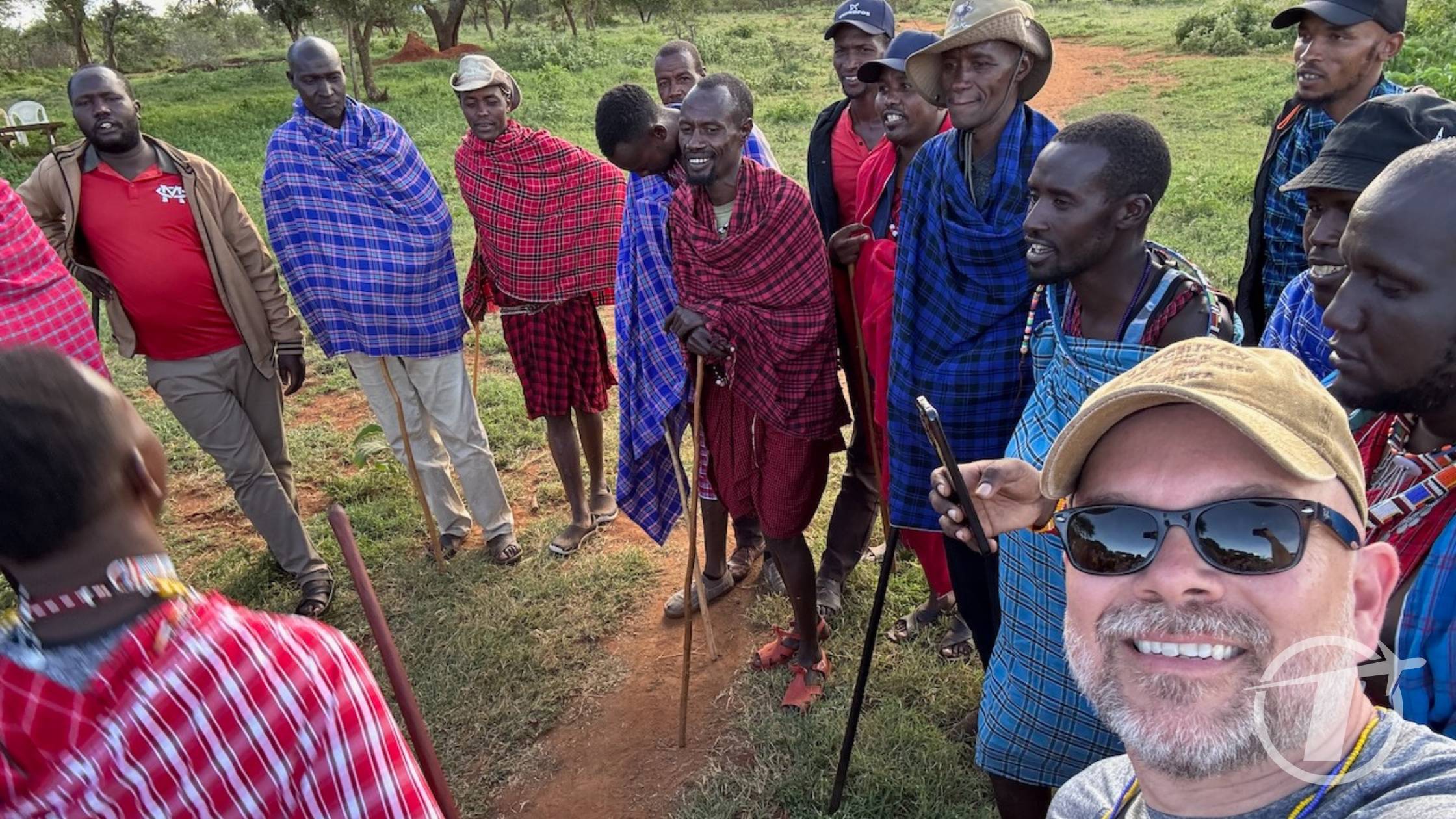
We were welcomed individually, one by one — not as a tourist group being shuffled through, but personally. The traditional dances and warrior rituals that followed weren’t staged for us. They’re living expressions of identity passed down through generations.
The Shuka, the Chief, and a Meal That Mattered
Each of us was gifted a beaded bracelet, a beaded necklace, and a shuka — the iconic red-checked cloth that represents identity, courage, and cultural pride for the Maasai. Receiving one felt like being welcomed into something sacred.
Lunch was traditional: rice, beef stew, cabbage, chicken, goat, tortillas, fruit. Simple food. And we shared it with the village chief, his translator beside him. I can’t fully explain why that moment hit the way it did — but sitting at that table felt like an extraordinary honor.
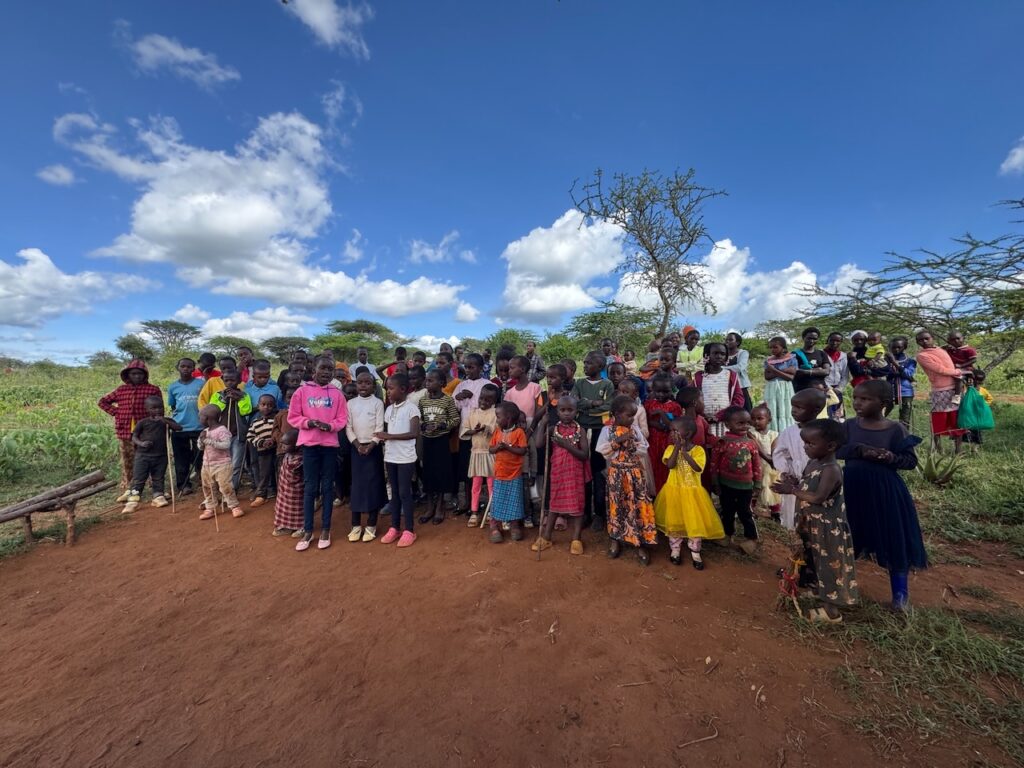
We toured the village afterward, including several mud huts built from mud, sticks, grass, cow dung, and ash — engineered for the environment in ways that would impress any architect. Then we gathered at their outdoor worship space. The children sang Bible songs and recited scripture. The Maasai in this village are Christians, and their faith is as woven into daily life as any tradition they keep. Watching those children sing is something I’ll carry home.
Then we handed out candy. “Sweets,” the children called them. You would have thought we handed each one a winning lottery ticket. That kind of joy — unfiltered, uncomplicated — doesn’t leave you.
The Watering Hole
Then we were taken to where they get their water. To wash. To bathe. To drink. The water is dark. It’s shared with animals. And they have no alternative.
SKYIN Safari has launched a nonprofit to raise $50,000 to drill a clean water well for this village — with plans to build a school next, so the children don’t have to make long, dangerous walks through animal territory just to get an education. I’m proud to travel with a company that operates this way, and I’m proud to partner with them going forward.
These people have very little by any material measure. But they have each other, they have their faith, and today they had us. We were the lucky ones.
Day 4 — Lake Naivasha
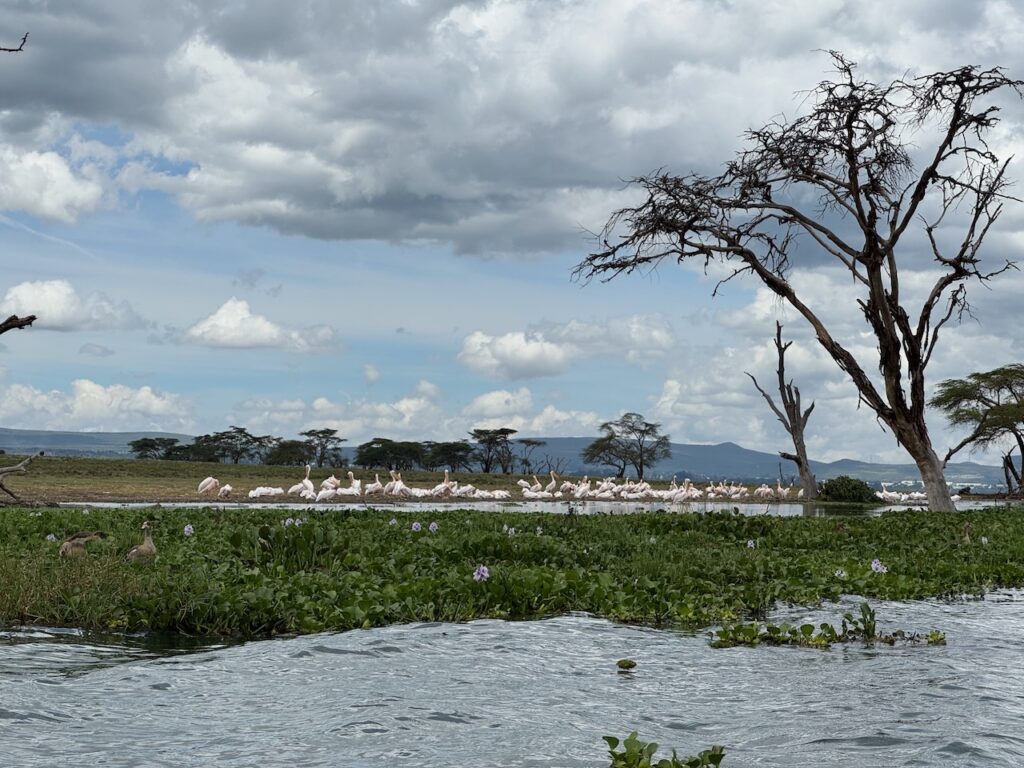 Hippos, flamingos, a Hollywood island, and a spotlight walk in the dark.
After a slower morning — a little extra sleep goes a long way on safari — we loaded up and made our way toward Lake Naivasha, stopping first at the Great Rift Valley overlook. Standing there and looking out over that geological wonder is the kind of moment that makes you stop talking for a minute.
Lake Naivasha is Kenya’s only freshwater lake within the Great Rift Valley, sitting at 1,884 meters above sea level. Its Maasai name means “that which heaves” — a nod to the sudden waves that can sweep across its surface. On this day it was calm and beautiful.
On the Water
We boarded small motorized boats with a local guide and headed out to explore. Almost immediately: giraffes and waterbucks wading into the lake along the shoreline. Then we found the hippos. A quick fact that surprises most people: hippos can’t actually swim. They stay in shallow water, floating and pushing off the bottom. Their skin is incredibly sensitive to sunlight, so they spend their days submerged — and come out at night to graze.
Crescent Island, visible from the lake, is a private wildlife sanctuary where visitors can walk freely among giraffes, zebras, wildebeest, and waterbuck with no predators present. It was once a peninsula, surrounded by rising water levels over time. And for the film buffs: it was used as a filming location for the 1985 Oscar-winning Out of Africa. The larger predators were relocated after filming, and the gentler species have been thriving there ever since.
Lunch at Lake Elmenteita Serena Camp
Lunch was at Lake Elmenteita Serena Camp — a stunning luxury property with an open-air dining room overlooking the lake. A gentle rain moved through while we ate, dropping the temperature and making the whole scene feel cinematic. Hundreds of flamingos lined one section of the water in a blaze of pink. One of those lunches you remember.
Hippos After Dark
That evening at Lake Naivasha Sopa Resort, one of the security staff took our group out after dinner with a spotlight to watch the hippos emerge from the water to graze. Seeing those massive animals lumbering around at close range in the dark is an experience that stays with you. Highly recommend it if you’re ever given the option.
Day 5 — Lake Nakuru National Park
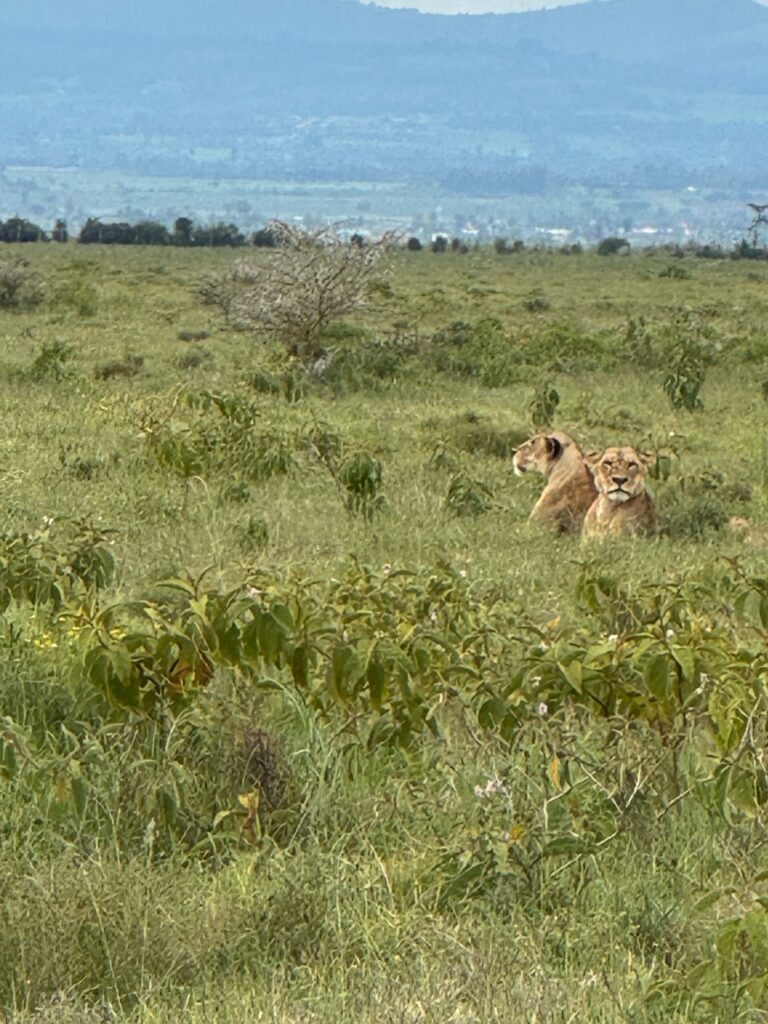 Four of the Big Five, a tiny antelope with a memorable name, and the Maasai Mara on the horizon.
I want to note something for context: our itinerary moves faster than a typical client trip would. This is a FAM trip — which means we’re changing properties every night and stopping to tour lodges along the way. It’s a lot of ground, but that’s the point. We’re vetting everything so you don’t have to guess.
Lake Nakuru National Park sits in the Great Rift Valley at about 5,700 feet of elevation and covers roughly 188 square miles. It’s one of Kenya’s most celebrated wildlife sanctuaries, best known as a protected rhino habitat — both black and white rhinos call it home. The afternoon rain cooled things off significantly; at that altitude, a little rain goes a long way.
Day 5’s game drive was spectacular. In a single morning we spotted:
- Female lions
- Hyenas
- Black and white rhinos
- Warthogs, zebras, and giraffes
- Pelicans, flamingos by the thousands, and water buffalo
- Dik-dik — a tiny antelope standing less than 16 inches tall. Yes, that’s its actual name.
That put us at four of the Big Five. The only one still eluding us was the leopard. And we still had two days left.
Lunch was at the Cliffs of Lake Nakuru Resort — a luxury glamping property with views that had no right being that beautiful. Most of us tried the Nile Perch, a freshwater fish from the region that’s light, flaky, and delicious. Highly recommend.
Days 6 & 7 — The Maasai Mara
Lions on a kill, a balloon at sunrise, and a leopard with ten minutes to spare.
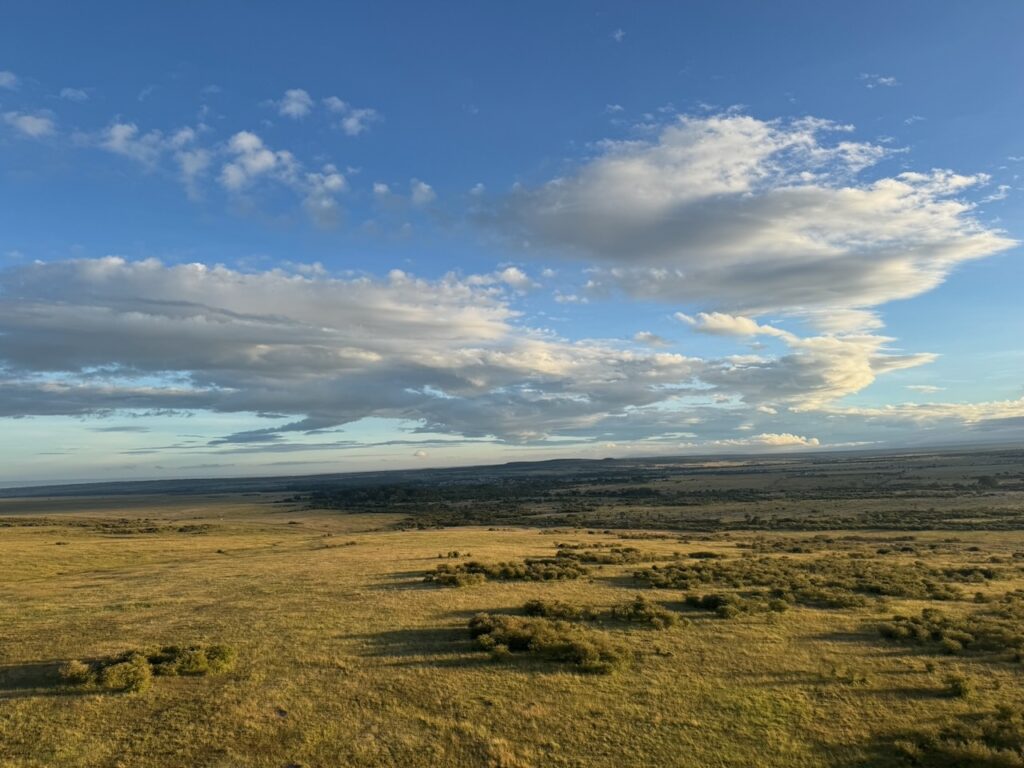
We woke up to a sunrise that had no business being that beautiful — the kind that makes you stand there in silence before remembering you have somewhere to be. Then came the long drive to the Maasai Mara. Worth every kilometer.
The Mara spans roughly 580 square miles in southwestern Kenya and is part of the Mara-Serengeti ecosystem — one of the most biodiverse regions on the planet. It’s famous for the Great Migration, when over 1.5 million wildebeest and hundreds of thousands of zebra make their annual crossing between Tanzania and Kenya. But even outside migration season, the Mara delivers. And did it ever.
A Scene I Didn’t Expect
On our first afternoon game drive, we came across a male lion standing guard over a Cape buffalo his pride had taken down earlier in the day. Before we could fully process that scene, two more males approached — close enough that the moment felt almost surreal. They weren’t performing. They weren’t threatened by the vehicle. They were just lions, doing what lions do.
We watched them feed. It’s raw. Nature doesn’t edit itself. But that’s exactly what makes it extraordinary. The Maasai Mara has one of the highest concentrations of lions in Africa, and witnessing an active feeding is something most safari travelers never get to see. We did.
One thing worth knowing about the Mara: unlike a national park, it’s managed by the local county government, which allows off-road driving in certain areas. That means your guide can get you significantly closer to wildlife than a standard park road would ever allow.
Hot Air Balloon at Sunrise — Non-Negotiable
Day 7 started before the sun. We launched at first light for a sunrise balloon ride over the Mara — and it delivered everything you’d hope for and then some. Seeing elephants, hippos, and wildebeest from the air, hearing the elephants trumpet and the hippos snort from above the morning mist — that’s the kind of thing that makes you stop and really understand where you are. If you’re booking the Mara, make this a non-negotiable.
The Leopard
With about ten minutes left in our final game drive of the trip, we spotted a leopard. That completed the Big Five. To see all five on a single safari trip is genuinely rare — it takes the right parks, the right guide, and a little luck. We had all three. That moment, in the final sliver of our final drive, was the perfect ending.
We spent both nights in the Mara at luxury glamping properties. I know what “glamping” might conjure in your mind. Set that aside. We’re talking spacious canvas tents with full electricity, proper bathrooms, and high-end finishes, while the African bush hums just outside your walls. Security roams the property through the night. Our second tent overlooked a river where hippos moved in the dark below. That’s not roughing it — that’s as close to the wild as you can get while sleeping in genuine comfort.
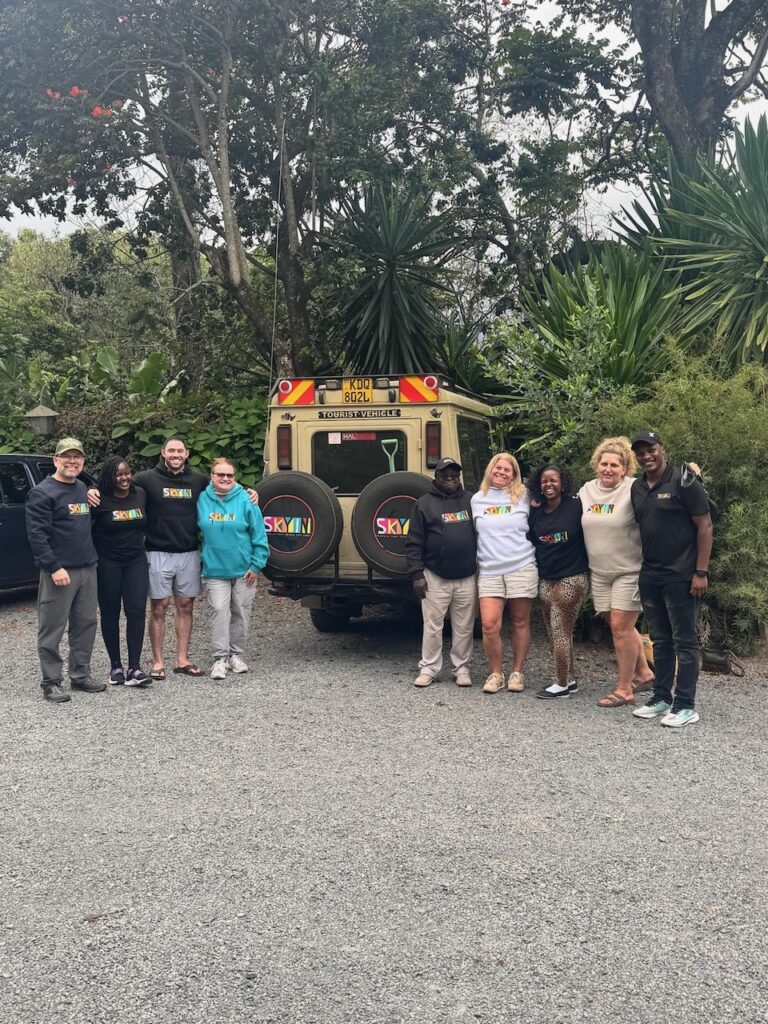 The Last Day — And What I’m Bringing Home
Day 8 was a long drive back to Nairobi for a farewell lunch with the full SKYIN team before we all split off to our separate corners of the world. It was one of those quiet, good kinds of tired — the kind that comes from a week of experiencing something that actually mattered.
I came home with a suitcase full of dusty clothes, a camera full of memories I’m still sorting through, and a perspective that I think will take a while to fully settle. The wildlife was extraordinary. The lodges were exceptional. But what I keep coming back to is Day 3 — sitting in a mud hut village in Amboseli, watching children sing with everything they had, and then being taken to the dark water they drink. That stays with you differently than a lion or a balloon ride. Both kinds of memories matter.
Kenya is the real thing. And I can’t wait to send people there.
Thinking About Kenya?
If this journal has you wondering whether a Kenya safari might be right for you, I’d love to help you find out. As a travel advisor who has lived this trip firsthand, I can help you build an itinerary that fits your travel style, your pace, and what matters most to you.
Start the conversation at treytracytravel.com/planning-process/.